
Contents
- Jodie Rollason to join Financial Rights as CEO
- How much longer will CBA defend the indefensible?
- Reforms mean Centrepay will no longer be a vehicle for abuse, say advocates
- Building Futures not Barriers: Super That Works
- Bringing the financial services sector up to code
- First Nations advocates welcome $3.5million penalty of ACBF/Youpla for misleading community about being Aboriginal owned
- Updated sector guidance on Credit Reporting & Economic Abuse
- CFA Consumer advocacy award
- New Message Stick newsletter from Mob Strong
1. Jodie Rollason to join Financial Rights as CEO
The board of Financial Rights Legal Centre is happy to announce the appointment of Jodie Rollason as our new Chief Executive Officer, effective 1 December. She will succeed Karen Cox, who is stepping down after 25 years of dedicated service.

Ms Rollason brings many years of senior leadership across the legal, community services, and not-for-profit sectors. In the search for a new CEO, the Financial Rights Board was struck by Jodie’s deep commitment to social justice and her focus on supporting people experiencing vulnerability. She brings a courageous, compassionate approach to leadership that aligns perfectly with the values of Financial Rights.
Board members cited Rollason’s career dedicated to delivering strong social impact. “Noting Jodie’s track record of multi-disciplinary service delivery, fundraising and building cross-sector partnerships for specialist services, we know Financial Rights is in good hands.”
Karen warmly welcomes Jodie into Financial Rights: “After 25 years, it is time for me to start a new chapter, and time for new leadership at Financial Rights. Ms Rollason will be taking charge of an organisation full of talented, passionate and committed people, who are ready to carry on our important work. We are in a very strong position, with more long-term and recurrent funding arrangements for our services than ever before.”
Jodie is an experienced Chief Executive Officer and Non-Executive Director. Jodie currently serves as CEO and Company Secretary of Mountains Youth Services Team, where she has led significant change, increasing funding streams, expanding regional service delivery, and strengthening governance and compliance. Her board portfolio includes Non-Executive Director roles with Lifeline Central West, Women’s Plans Foundation (Int’l) and Koorana Child and Family Services, where she chairs the Risk Committee.
Jodie has a Masters in Commercial Litigation and is a qualified lawyer. She is passionate about advocacy for vulnerable communities and leading with compassion, fairness, and integrity. Jodie has experience in building high-performing, values-driven teams.
Jodie will continue to implement the Financial Rights Strategic Plan 2024-2028, including exploring independence options for Mob Strong Debt Help.
2. How much longer will CBA defend the indefensible?
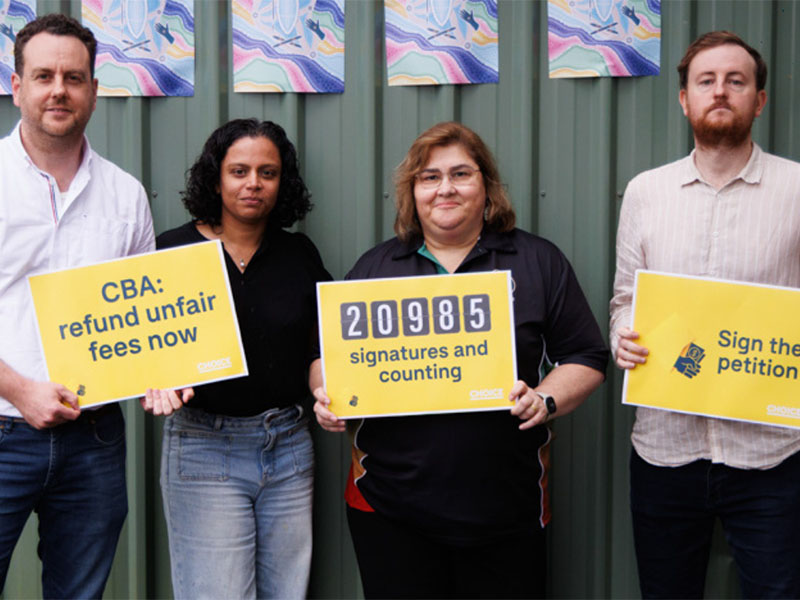
The memory of the Royal Commission and the bad taste left by excessive greed seems to be fading fast for CBA.
Last year ASIC extracted $33 million dollars in fee refunds for First Nations Australians who should have been in low fee accounts. CBA accounted for a whopping $25 million of that refunded money. Another report from ASIC published last month has found that the problem was far broader than just First Nations people on government benefits.
Most of the banks identified in the ASIC report have committed to refund another $60 million to over 770,000 customers. They will also move 820,000 customers to low-fee accounts, and implement process improvements to reduce future harm. This is a fair outcome that tries to remediate people to where they would have been had they been in appropriate bank accounts.
But CBA has taken a different tack. ASIC’s report says that CBA (including Bankwest) provided it with data indicating that, between July 2019 and October 2024, it charged approximately $270 million in fees (including account-keeping, dishonour and overdraw fees) to about 2.2 million low-income customers beyond the original cohort of customers.
Penny pinching on account fees received from low-income people doing it tough in a cost-of-living crisis is not great optics – particularly given the recent $10.25 billion profit announcement. And when your rivals are stepping up and doing the right thing and returning fees, some with interest – it starts to look like profiteering from the most vulnerable consumers.
CBA’s behaviour certainly takes the sheen off a recent ABA report on customer trends, that show transaction account service fees as a percentage of bank income has dropped from 8% in 2004 to 2% in 2024. It claims that in 2024 banks saved customers more than $500 million by providing no or low fee accounts to vulnerable customers such as government benefit recipients, students and the elderly. Which is pretty awkward, given the bank with the most customers has just said it won’t give back the money we know it shouldn’t have been taking in the first place.
So far, CBA has chosen to ride out the storm, waiting for the outrage of its behaviour go away.
Consumer groups won’t let that happen. Over 20,000 people have already signed a petition from Choice, urging CBA to give the money back. CBA should rightfully feel the fire of public outrage over their decision to keep $270 million in dodgy fees paid by Australians doing it tough.
The question is – how long will they defend the indefensible?
3. Reforms mean Centrepay will no longer be a vehicle for abuse, say advocates
Consumer advocates have welcomed the finalised reforms to Centrepay announced by Minister Katy Gallagher in early September. Key reforms that will be phased in this year include:
- Removing high-risk service reasons like funeral expenses, consumer leases and household goods.
- New businesses signing up to Centrepay will be held to a higher standard before being able to access people’s Centrelink income.
- Centrepay now has much stronger enforcement and compliance tools to hold businesses accountable for following the rules.
- It will be much easier for Centrepay users and consumer advocates to make complaints about unscrupulous businesses.
- Businesses will no longer be able to sign people up for never-ending deductions with no target amounts or end dates.
The reforms will restore Centrepay’s original purpose – that is, it should only be used to make voluntary regular payments for essential bills and expenses. The reforms focus on improving customer protections and reducing the risk of financial harm to people receiving Centrelink income.
Centrepay is an invaluable service for social security recipients, but consumer advocates have been raising concerns about its misuse for decades. We applaud Minister Gallagher and Services Australia CEO David Hazelhurst for their willingness to take up the bat for people who have been let down by successive governments which failed to act on the reported misuse of Centrepay.
The Centrepay reform team’s engagement with First Nations and other consumer advocates over the last 2 years has been exceptional, and a true consultation. All government departments can learn from their open and collaborative approach to achieve fair outcomes.
Read our full media release.
4. Building Futures not Barriers: Super That Works

Australia’s $4 trillion superannuation system is failing First Nations peoples – denying many access to their own money in retirement, during financial hardship or after the death of a loved one. This means that First Nations Australians are more likely to miss out on the benefits of super and are twice as likely to have lost or unclaimed super compared to the national average.
Independent research commissioned by Super Consumers Australia with Mob Strong Debt Help and Impact Economics and Policy, highlights the systemic barriers First Nations peoples face including rigid policies, inaccessible customer service and a lack of accountability.
The research found that:
- First Nations peoples are denied access to their own super even in retirement or financial hardship because of unreasonable barriers in proving who they are;
- customer service failures disengaged consumers, driving some to abandon their rights; and
- First Nations peoples face enormous barriers to accessing death benefits and they are taking significantly longer to pay out.
“Superannuation is meant to be a retirement safety net for all Australians. But too many First Nations peoples are shut out of a system that is meant to serve us”, says Mark Holden, Senior Solicitor from Mob Strong Debt Help. “Rigid ID verification rules, culturally unsafe customer service and a reliance on digital-only processes means it can take our mob months or even years to access their own money, if they are still alive.”
Read the full report.
5. Bringing the financial services sector up to code
Central to the work our financial counsellors and solicitors do every day in protecting the rights of our clients are the self-regulatory financial services codes of practice. These include the Banking Code of Practice, the General Insurance Code of Practice, Life Insurance Code of Practice and a range of other codes covering everything from insurance brokers to buy now pay later providers. Codes of practice can bridge an important gap between governing legislation and the delivery of fair and just outcomes for consumers.
And now for the first time in 20 years, the Australian Securities and investments Commission (ASIC) is reviewing and redrafting the guiding regulatory document that governs the approval of these codes.
Financial Rights has taken the opportunity to lead the consumer movement’s submission to the review raising a series of concerns we have with the financial service sector’s approach to self-regulation.
In the 20 years since 2005, when ASIC first introduced RG 183 there has only been one industry Code approved: the Australian Banking Association’s (ABA) Banking Code of Practice. Further, only five code owners have agreed to have their codes be independently monitored and enforced. All other sectors of the financial services industry fail this basic test. Where sectors have in fact agreed to independent monitoring there remain significant issues that impact upon their effectiveness in providing robust rights and protections for consumers. These include – among others: the varied ability for consumers to individually enforce code commitments; an over-reliance on vagaries and weasel words that set far from adequate standards, and limited sanction powers have not had a real deterrent effect including the lack of regularly naming firms that breach codes.
This is not the type of track record that screams success.
To be effective codes of practice need to be rigorous. If they aren’t, then codes only serve to confuse and obscure consumer protections and regulation.
Allowing industries to self-regulate through codes of practice needs to be acknowledged for what it is: a privilege not a right – one bestowed by the Australian community with the expectation of onerous and self-imposed meaningful consumer protections.
In reviewing RG 183, we have called upon ASIC to consider how they can best ensure codes continue to be written for consumers, offer protections better than at law and meet the needs of consumers. The submission has put forward a series of recommendations to help ASIC achieve just that.
Ultimately though if the issues we have raised remain unaddressed, it always remains open for the community, consumer groups and the Government to consider other approaches to regulating financial products and services and credit activities.
Read the joint consumer submission to the ASIC update of Regulatory Guide 183 Approval of financial services sector codes of conduct here.
6. First Nations advocates welcome $3.5million penalty of ACBF/Youpla for misleading community about being Aboriginal owned
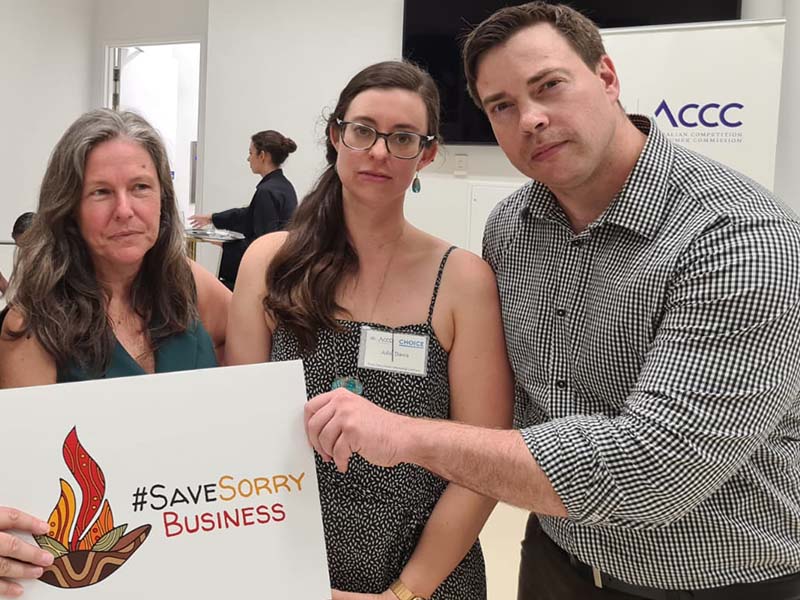
In July, the Federal Court imposed a $3.5 million penalty imposed on ACBF Funeral Plans Pty ltd (ACBF).
The Save Sorry Business Coalition welcomed this news, having fought ACBF for decades on their systemic misrepresentation to First Nations people about their dodgy product. ACBF misled the community about their business being Aboriginal owned by using Aboriginal imagery on their contracts, clothing and business cards.
The Australian Securities and Investment Commission (ASIC) commenced proceedings against ACBF in 2020 alleging, amongst other things that, that ACBF made misrepresentations between 2015 and 2018 that it was owned or managed by an Aboriginal person or persons when it was not.
Whilst the Federal Court imposed a $1.2 million pecuniary penalty on the successful claim, consumer advocates were gutted when the primary judge rejected the ownership allegation on the basis that while the representations had been made, ASIC had failed to prove they were not true.
ASIC made a successful 2024 Full Federal Court appeal on this point. The appeal court found that the evidence supported that ACBF was not Aboriginal owned during the relevant period, despite misrepresenting to the community that it was. Advocates welcome the substantial penalty for representing you are Aboriginal owned when you are not and that ASIC has shown other businesses that it will take action against this conduct.
Save Sorry Business Co-ordinator Bettina Cooper said: “This penalty doesn’t help the thousands of people who were deceived into thinking they were buying a funeral plan from an Aboriginal owned business. But it very clearly warns other businesses that if you claim or imply you are a First Nations business in order to make money and advantage of community and you are not, you will be held to account”.
Reflecting on the deliberateness of ABCF/Youpla’s behaviour, in his written comments Justice Goodman stated: “ASIC submitted that the making of the Aboriginal Ownership/Management Representation was deliberate and callous and involved egregious conduct. I agree”.
Ms Cooper continued: “The finding around ABCF misrepresenting being an Aboriginal owned organisation was incredibly distressing for community and made it hard to fully appreciate the broader findings about ABCF’s conduct. But ASIC listened and acted to appeal this principle. We thank ASIC for pursuing this very important matter for all the people who were misled by ABCF/Youpla”.
She concluded: “The ACBF Court of Appeal decision sets an important precedent on misrepresentation of First Nations ownership or ‘blackcladding’. Government agencies should continue to identify and take action against black-cladding, so legitimate First Nations owned organisations are able to flourish and support their community”.
7. Updated sector guidance on Credit Reporting & Economic

We recently updated our publication Credit Reporting & Economic Abuse: A practical guideline for financial counsellors and community workers. This guide is a tool for domestic and family violence advocates, caseworkers, community lawyers and financial counsellors seeking to navigate credit reporting issues. The full guide is available in the Publications section of our website.
8. CFA Consumer advocacy award

Financial Rights and Mob Strong are the proud recipients of the Consumers’ Federation of Australia 2025 Consumer Advocacy Award for our decade-long Centrepay reform campaign. You can read all about the outcomes in this edition of the E-Flyer.
This reform work needed a broad coalition to succeed, and we worked closely with a whole range of organisations. We’d like to particularly thank Economic Justice Australia, Indigenous Consumer Assistance Network, Money Mob Talkabout, CatholicCare NT, Consumer Action Law Centre Brotherhood of St Laurence, Financial Counselling Australia, Choice, Anglicare N,T Welfare Rights & Advocacy Service, Consumer Credit Legal Service (WA), South Australian Financial Counsellors Association, Australian Council of Social Service, Financial Counselling Victoria, Redfern Legal Centre, and Care Financial Counselling.
We also acknowledge the strong leadership from Bill Shorten in his role as Minister for Services Australia, and the dedicated management and staff at Services Australia, who have ensured the reformed Centrepay will work much better for users of that service.
A huge thank you to everyone involved in this campaign – especially our clients who were brave enough to speak up and help us to bring about these much needed reforms.
9. New Message Stick newsletter from Mob Strong
Mob Strong Debt help is about to launch something deadly – “Mob Strong Message Stick” – a new newsletter sharing powerful yarns, victories, and tools straight from the frontline of our path to financial justice.
The newsletter will be an inside look at-
- Advocacy and policy battles we are taking on (and winning!)
- What is happening on the ground in the communities we reach through our Outreach.
- Practical tools, fact sheets and reports to help shield Mob from financial harm.
- Updates on our journey to becoming an independent First Nations led organisation – including how you can be a part of our story.