

Contents
- Mitali Tyagi joins Financial Rights
- Cross-sector coalition unites to tackle Australia’s home insurance crisis
- Mob Strong walks pathway toward independence
- Consumer wins off to a flying start in 2026
- Bankruptcy law reform stagnates
- Youpla update
- New and updated resources for caseworkers
- New community language resources in NSW
1. Mitali Tyagi joins Financial Rights

Financial Rights Legal Centre warmly welcomes Ms Mitali Tyagi as interim CEO.
Mitali joins us as an accomplished leader who has dedicated her career to advancing economic equity and fairness. Mitali has been a member of the Financial Rights Board of Directors since 2023 and will lead us while the Board recruits our permanent CEO.
Mitali is a strong believer in the power of advocacy, collaboration, and principled leadership in paving the way for fairer financial systems worldwide. Over the past decade, she has represented the interests of countries in the Asia-Pacific, especially Small Island Pacific States and developing nations in global forums through the Financial Action Task Force. Her work focuses on financial inclusion, robust systems for financial integrity and regulation of financial institutions, and equitable application of rules across economies. Previously, Mitali held roles as a practising lawyer at the Attorney-General’s Department and Mallesons. Her commitment to community legal service began early in her career with the Welfare Rights and Cape York Land Council.
A permanent CEO appointment is expected in late-2026.
2. Cross-sector coalition unites to tackle Australia’s home insurance crisis
Home insurance affordability in Australia is deteriorating rapidly as climate risks intensify and construction costs rise. The Actuaries Institute’s home insurance affordability index shows the proportion of households facing unaffordable insurance climbed from 10% in 2022 to 15% in 2024, equivalent to 1.6 million homes. APRA estimates that around one in seven Australian houses is currently uninsured, a figure that could rise to one in four by 2050.
The impacts are most severe in regional and rural communities, particularly in lower-income areas and older “legacy homes” built before modern climate risks were understood. In some cases, households face recovery periods of up to a decade without insurance, compared to six to twelve months for insured households.

This report argues the crisis is not driven by individual household decisions, rather by the way the insurance, banking, housing and government systems currently interact.
A system-wide problem requires system-wide solutions – and the Housing Resilience Action Plan 2030 has been developed to achieve just this. The Action Plan was developed by Monash University, Financial Rights Legal Centre, Financial Counselling Victoria, the Resilient Building Council, Finity and ARC Justice, following a workshop of approximately 50 experts from government, insurance, banking, investment, academia and the community sector held in December 2025.
“Households need relevant and appropriate risk and resilience information that they can act on and have that reflected in their insurance premiums. This Action Plan will empower Australians to make their homes safer and ensure their financial security into the future”. Julia Davis, Senior Policy and Communications Officer at Financial Rights Legal Centre.
Improved data-sharing, more consistent pricing signals and practical pathways for investing in resilience would enable households to respond more effectively as risks increase. The Plan’s high-level recommendations can be found in this media release, but we encourage you to read the full Plan.
3. Mob Strong walks pathway toward independence
This year has been particularly significant for our First Nations led service, Mob Strong Debt Help as they begin their journey toward becoming an independent organisation.
Our Strategic Plan 2025-2028 requires Financial Rights to establish a First Nations Committee, and tasks that committee with exploring the feasibility of Mob Strong becoming a standalone First Nations controlled organisation.
Committee members are:
- Adrian Ahern
- Professor Kerry Bodle
- Heron Loban
- Daniel Scoullar and
- Kimberley Peckham
This First Nations-led Steering Committee will determine the best way forward for Mob Strong. The high-level plan is the creation of a national Aboriginal Community Controlled Organisation to be established, providing legal, financial, and other support to First Nations people and communities.
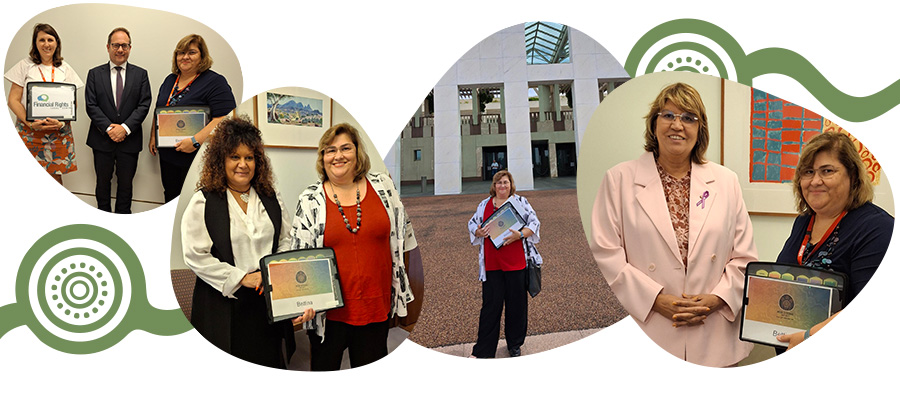
Mob Strong Debt Help also visited Canberra during the first sitting week of the year, to meet with politicians and government agencies about the independence pathway, and emphasise the need for secure, ongoing funding for Mob Strong Debt Help services. The need for superannuation customer service standards and the rise in consumer complaints about energy were also key discussion topics.
You can stay up to date with all the latest Mob Strong developments and achievements by signing up to the Message Stick newsletter.
4. Consumer wins off to a flying start in 2026
If the first quarter of the year is anything to go by, 2026 is shaping up as an epic year for consumer advocacy.
In March, the Fair Call Coalition (led by the Australian Communications Consumer Action Network) succeeded in convincing the Australian Communications and Media Authority (ACMA) to not approve the industry-developed Telecommunications Consumer Protection Code. The ACMA will instead determine an enforceable industry standard to replace the TCP Code – a seismic change after decades of ineffective self-regulation.
Also in March, we applauded the findings of a report to the NSW government recommending banning commissions for strata managers. Conflicts of interest have plagued the strata and insurance sectors for years, so the Productivity and Equality Commission’s (PEC) report findings were no surprise to Financial Rights. Strata managers should not be getting paid by an insurer for recommending their products – the state government needs to act quickly to stamp out insidious and unnecessary fees that are exacerbating cost of living pressures on strata owners.
At the start of April, legislation to introduce an Unfair Trading Prohibition entered the Federal Parliament. This reform has been over a decade in the making. Financial Rights wants to see this reform extended to financial services – a sector that is also rife with unfair trading practices and subsequent consumer harms. This campaign was led by the Consumer Policy Research Centre, who have also published a neat explainer of the unfair trading issue and what the ban will achieve.
And finally, with little fanfare, CBA announced its intention to provide $68 million in “goodwill payments” to some concession customers who incurred unusually high fees at the very end of 2025. The “goodwill payments” were in response to the uproar from consumer groups after ASIC revealed CBA had pocketed $270 million in dodgy fees paid from Australians doing it tough.
Many of these wins were a long time coming and the result of coalitions of consumer groups working together – so congratulations to our sector colleagues involved in achieving these hard-earned breakthroughs.
5. Bankruptcy law reform stagnates
Disappointingly, we are still waiting for legislation to enact the substantial bankruptcy reforms announced by the government in July 2024. This is incredibly frustrating for the consumer sector, who continue to assist people with relatively small debts, no assets, who are fearful of the consequences of 3 years bankruptcy and permanent listing on the National Personal Insolvency Index.
The other key bankruptcy reform that remains outstanding is a Minimal Asset Procedure. This consultation was undertaken in September 2023 and Financial Rights has met multiple times with the Attorney General’s Department, and later with Treasury officials, to discuss how this work is progressing.
In the year and half that we have been in close contact with government agencies on this matter, we continue to see no evidence of progress toward developing a MAP. It is very disappointing to us that most submissions to the public consultation were supportive, apart from businesses who would be impacted by people having a more appropriate bankruptcy option.
6. Youpla update
The Youpla Support Program continues to provide an enduring insurance provider, Youpla Group (also known as the Aboriginal Community Benefits Fund).
As of mid-February 2026, a total of $50.4 million has been paid out for around 32,000 policies to over 11,000 people. 17 policies were paid as funeral bonds to 15 people, totalling around $78,500.
With most eligible people having now received their Youpla Support Program payment, efforts are continuing to focus on complex cases and hard-to-reach customers.
Mob Strong continues to support people impacted by Youpla by providing financial counselling relating to their resolution payment. They play an ongoing role raising awareness and sharing information about the program through their networks and independent outreach activities, as well as advice and guidance to people who call through to Mob Strong.
The Youpla Support Program will end on 1 December 2026.
7. New and updated resources for caseworkers

As part of our ongoing commitment to providing resources for caseworkers who are supporting clients, Financial Rights has published a new content and updated several fact sheets.
New content:
Updated fact sheets:
The (restricted access) Bankruptcy Toolkit has also been refreshed.
If you are a caseworker and you would like to provide feedback on our factsheets or request a new one, you can do so via this survey.
8. New community language resources in NSW
The Energy & Water Ombudsman NSW (EWON) has launched You’re Not Alone, a campaign aimed at increasing awareness of their free, fair, and independent dispute resolution services among multicultural and multilingual communities across New South Wales.
The campaign features videos, factsheets, postcards and social media tiles in Arabic, Cantonese, Mandarin, Hindi, and Korean, showcasing community members discussing how they use energy and water at home.
Free, in-language support is available for customers when they call EWON.
NSW Fair Trading has also recently expanded the range of information available in community language.
Factsheets are now available in a range of languages including Vietnamese, Chinese; Arabic, Assyrian, Turkish and Fasi and cover the following topics:
- Managing unpaid levies
- Financial hardship Information statement
- Strata reporting
- Buying a strata property
- Strata repairs and maintenance
- Strata renovation rules
More information is available on the Strata Publications webpage.